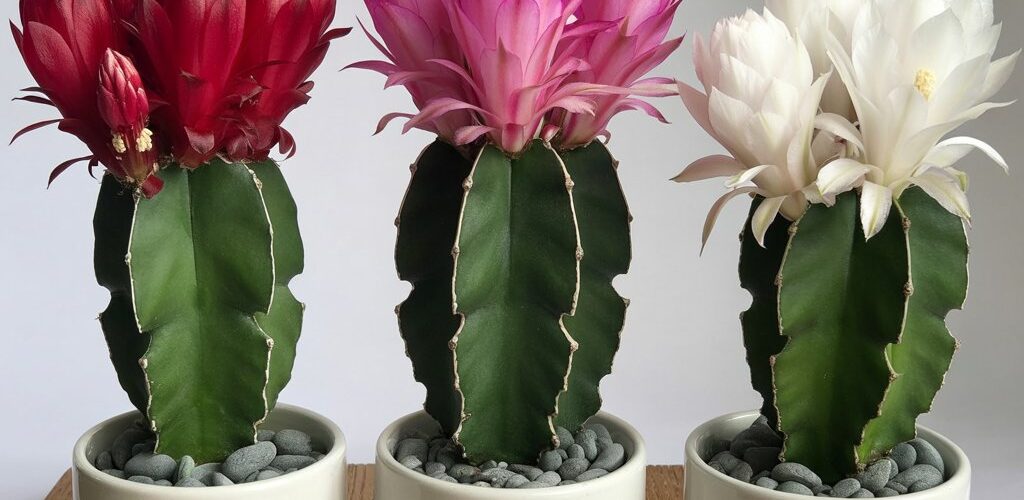
The Christmas Cactus, officially known as Schlumbergera, is the undisputed star of houseplants during the cold season. When most plants go dormant, it surprises us with an explosion of vibrant flowers in shades of red, pink, purple, or white.
However, we often buy a Christmas Cactus full of buds, only for it to refuse to bloom the following year. Why? The secret lies in the fact that it is not a desert cactus, but a tropical forest one.
Follow this simple guide, and your plant will be full of flowers right in time for the Holidays!
1. Light: Bright, But Not Direct
Unlike thorny desert cacti, the Christmas Cactus naturally grows in the shade of trees in Brazil.
- Ideal spot: An East or North-facing window.
- Golden Rule: It loves light, but direct sun burns its leaves (they will turn reddish).
- The Blooming Trick: The plant is photosensitive. To form buds, it needs short days. Starting in October, ensure it gets 12-14 hours of total darkness per night.
2. Temperature: Keep It Away from Radiator Heat!
This is the main reason why buds fall off before opening.
- Ideal temperature: Between 18°C and 22°C (64°F – 72°F) during the day.
- Warning: Never place the plant directly above a radiator or in the draft of an air conditioner. Drafts and dry air are its #1 enemies.
- Stimulating Blooming: A slight drop in temperature (to around 15-16°C / 59-61°F) during autumn helps the plant “understand” that it needs to produce flowers.
3. Watering: More Than a Regular Cactus
Although it has “cactus” in its name, it needs water more frequently.
- How often? The soil should be kept slightly moist, but not soaked. Check the soil with your finger: if the top 2-3 cm (1 inch) are dry, it’s time to water it.
- Common Mistake: Water sitting in the saucer quickly leads to root rot and soft leaves. Always discard excess water from the saucer 15 minutes after watering.
- Seasonal:
- Spring/Summer: Regular watering (weekly).
- Fall/Winter: Reduce watering (once every 2-3 weeks) to avoid “drowning” the plant during the cold period.
4. Fertilization and Feeding
- March – September: This is the vegetative growth period. Use a liquid fertilizer for green plants or cacti once a month.
- September – October: Switch to a fertilizer rich in Potassium and Phosphorus (for flowering plants) to support bud formation.
- November – December: Stop fertilizing while the plant is in bloom.
5. Repotting: It Likes Being “Crowded”
Don’t rush to change its pot! The Christmas Cactus blooms better when its roots are slightly root-bound (crowded) in the pot.
- When to repot? Once every 3-4 years, in the spring, after it has finished blooming.
- Substrate: Use an airy mix: potting soil mixed with perlite or tree bark (orchid substrate) for perfect drainage.
🆘 SOS: Why Is My Christmas Cactus Suffering?
1. Why do the buds fall off before opening? This is the most frustrating moment. The causes are:
- You moved the pot. DO NOT move or rotate the plant once the buds have appeared! It is very sensitive to changes in the angle of light.
- Cold drafts or sudden heat.
- Under-watering.
2. Why are the leaves soft and wrinkled? Usually due to excessive watering (roots have rotted and can no longer pull up water) OR a total lack of water. Check the soil.
3. Why isn’t it blooming at all? It didn’t get its “rest” period (darkness and coolness) in the autumn. Without this cycle, the plant continues to produce only green leaves.
Conclusion
The Christmas Cactus is a living jewel that can live for decades, often being passed down from generation to generation. With a little patience, indirect light, and respect for its rest period, it will reward you with a spectacular crown of flowers exactly when winter is at its hardest!
Have you got your Christmas Cactus ready for the holidays?